The Mystery of the Sleeping Comet
In a Nutshell
Ethan joins Cosmo on an unforgettable journey through the outer Solar System. Along the way, he learns how comets become bright, how asteroids differ from comets, and how meteors and meteorites are formed. Inspired by his adventure, Ethan grows up to become a planetary researcher.
Introduction
The Story
Twelve-year-old Ethan loved collecting unusual rocks.
Whenever his family went hiking, he searched for smooth stones, colorful minerals, and tiny fossils.
One day, while visiting the city's Space Science Museum, he noticed an unusual exhibit called The Sleeping Comet.
At the center of the room stood a glowing model of a frozen comet.
A sign beside it read:
"Every comet carries a story from the beginning of the Solar System."
Curious, Ethan gently touched the icy model.
The room suddenly filled with sparkling blue light.
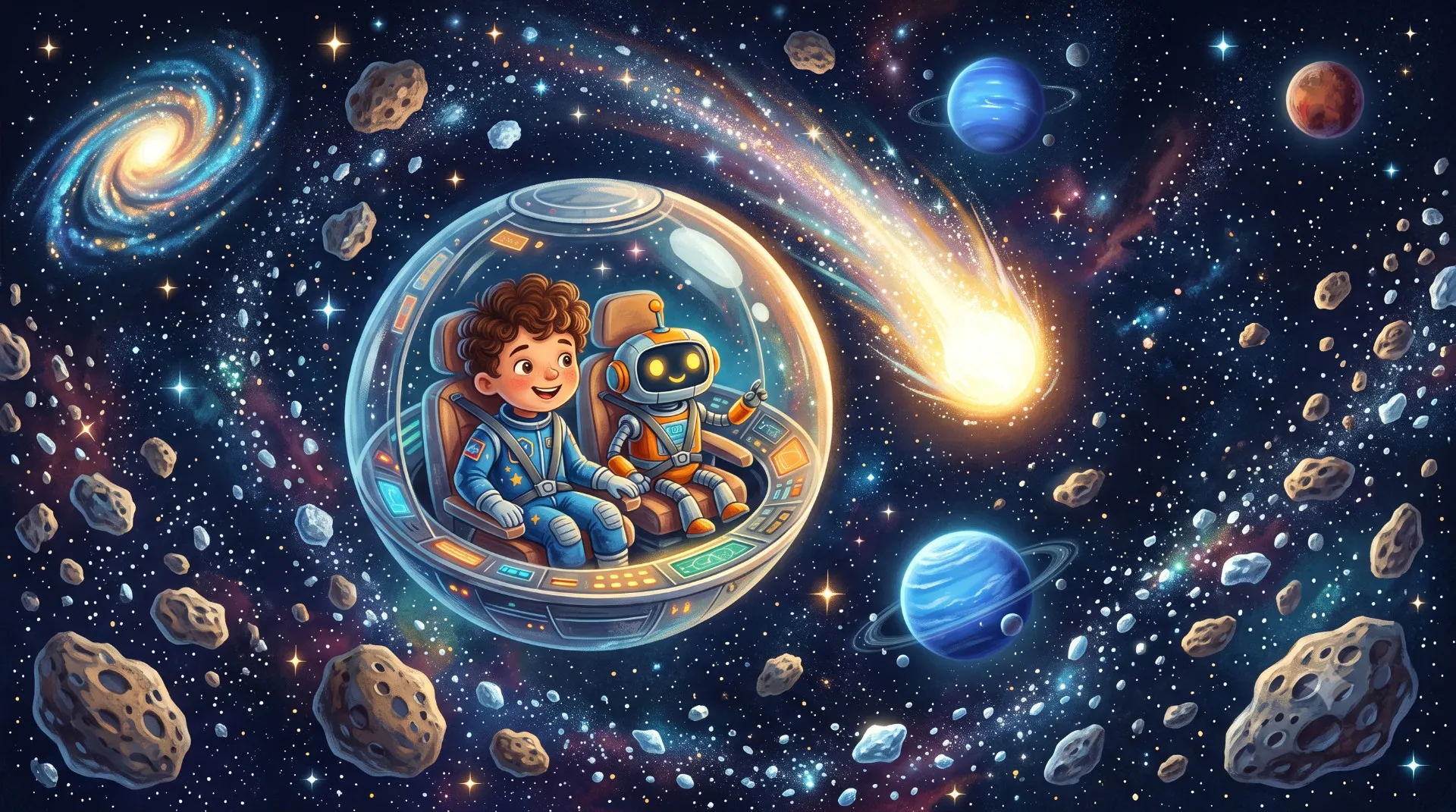
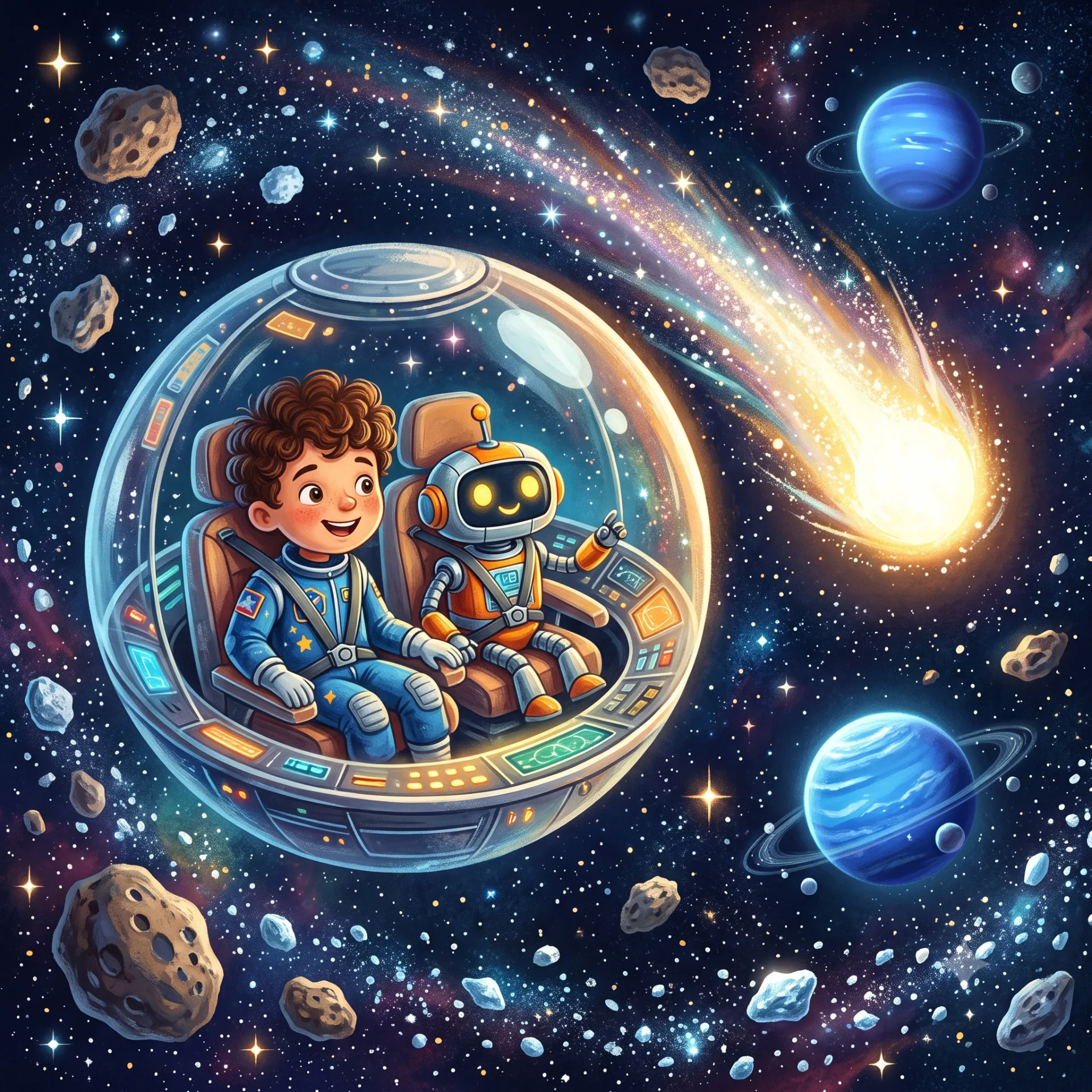
A friendly robotic guide appeared.
"My name is Cosmo," it said with a cheerful smile.
"Would you like to explore the outer Solar System?"
Before Ethan could answer, they were already traveling through space inside a transparent exploration capsule.
The Sun looked much smaller than it did from Earth.
The airless silence of space surrounded them.
Soon they reached a region filled with countless icy objects.
"Welcome to the Kuiper Belt," Cosmo explained.
"Many comets begin their long journeys from here."
Ethan looked around in amazement.
Some icy objects slowly drifted through space.
Others quietly orbited the Sun.
"They've been here for billions of years," Cosmo said.
"They are like frozen time capsules."
Suddenly, one of the icy objects began moving closer to the Sun.
As it traveled, something wonderful happened.
Its icy surface started to warm.
Clouds of gas and dust escaped into space.
A bright glowing tail appeared behind it.
"It's awake!" Ethan exclaimed.
Cosmo laughed.
"That's why some people call it a sleeping comet."
"A comet doesn't actually sleep. It only becomes bright when sunlight heats its frozen ice."
The glowing comet continued racing through space.
Its beautiful tail always pointed away from the Sun because of the solar wind and sunlight pushing tiny particles outward.
Farther along their journey, they entered another rocky region.
Large and small rocks floated quietly through space.
"This is where many asteroids travel," Cosmo explained.
"Asteroids are mostly made of rock and metal."
"They are different from icy comets."
Ethan carefully observed their rough surfaces.
Some were tiny.
Others were hundreds of kilometers wide.
Suddenly, one small rock drifted toward Earth.
As it entered Earth's atmosphere, it became extremely hot.
A bright streak of light flashed across the sky.
"A meteor!" Ethan shouted.
"Exactly," Cosmo replied.
"The heat of the atmosphere makes it glow."
The glowing object quickly broke into smaller pieces.
Most of it burned away.
However, one small piece survived the journey and landed safely on the ground.
"When a piece reaches Earth's surface," Cosmo explained,
"it is called a meteorite."
Ethan carefully wrote each new word into his notebook.
Comet.
Asteroid.
Meteor.
Meteorite.
Each one was different.
Each one had its own story.
Their journey continued toward the distant edge of the Solar System.
The planets looked tiny from so far away.
Cosmo pointed toward the darkness beyond Neptune.
"Farther than the Kuiper Belt lies the Oort Cloud."
"It is a giant shell of icy objects surrounding our Solar System."
"Some long-period comets begin their journeys there and may take thousands or even millions of years to return."
Ethan imagined a comet traveling through space for countless generations before finally becoming visible in Earth's night sky.
"It must be carrying secrets from the beginning of the Solar System," he whispered.
Cosmo nodded.
"Scientists study comets because they contain ancient ice, dust, and materials that formed billions of years ago."
"They help us understand how our Solar System was created."
Soon it was time to return home.
The exploration capsule gently landed back inside the museum.
Everything became quiet again.
The glowing comet model stood exactly where Ethan had first seen it.
Had he imagined the adventure?
Or had he really traveled across the Solar System?
Inspired by what he had learned, Ethan organized a Space Discovery Day at school.
He built models showing the differences between comets, asteroids, meteors, and meteorites.
His classmates were amazed to discover that these space objects were not the same.
Years later, Ethan became a planetary researcher.
He helped study samples collected from asteroids and comets by robotic space missions.
Whenever young visitors asked why he loved space, he smiled and answered,
"Every comet is a messenger from the past."
"And every discovery helps us understand where our Solar System began."
Vocabulary Words
The Moral
Studying space helps us understand the history of our Solar System and the universe around us.
Life Lesson
Studying space helps us understand the history of our Solar System and the universe around us.