The Classroom on the Space Station
In a Nutshell
Noah dreams of visiting a classroom aboard a space station. There, he experiences microgravity, performs science experiments, learns how astronauts live and work, and discovers that teamwork and curiosity are essential for exploring space.
Introduction
The Story
Eleven-year-old Noah loved science more than any other subject.
He often imagined floating among the stars and conducting experiments in space.
His bedroom walls were covered with pictures of planets, rockets, astronauts, and satellites.
One evening, after finishing his homework about the Solar System, Noah looked through his telescope.
"I wonder what it's really like to live in space," he whispered.
That night, he dreamed something extraordinary.
A silver shuttle gently landed in his backyard.
The door opened, and a smiling astronaut waved.
"Welcome aboard," she said.
"My name is Commander Elena."
"We're taking you to the International Learning Space Station."
Within minutes, the shuttle soared above the clouds.
Noah watched cities, mountains, rivers, and oceans grow smaller below.
Soon, Earth looked like a beautiful blue marble floating in the darkness of space.
The shuttle docked with a large space station that circled Earth.
Its long solar panels sparkled in the sunlight.
Inside, everything felt different.
As soon as Noah stepped through the airlock, he floated into the air.
He laughed.
"I'm flying!"
Commander Elena smiled.
"You're floating because we're in microgravity."
"Here, gravity still exists, but everything is constantly falling around Earth together. That's why astronauts feel weightless."
Noah gently pushed the wall with one finger.
He floated slowly across the room.
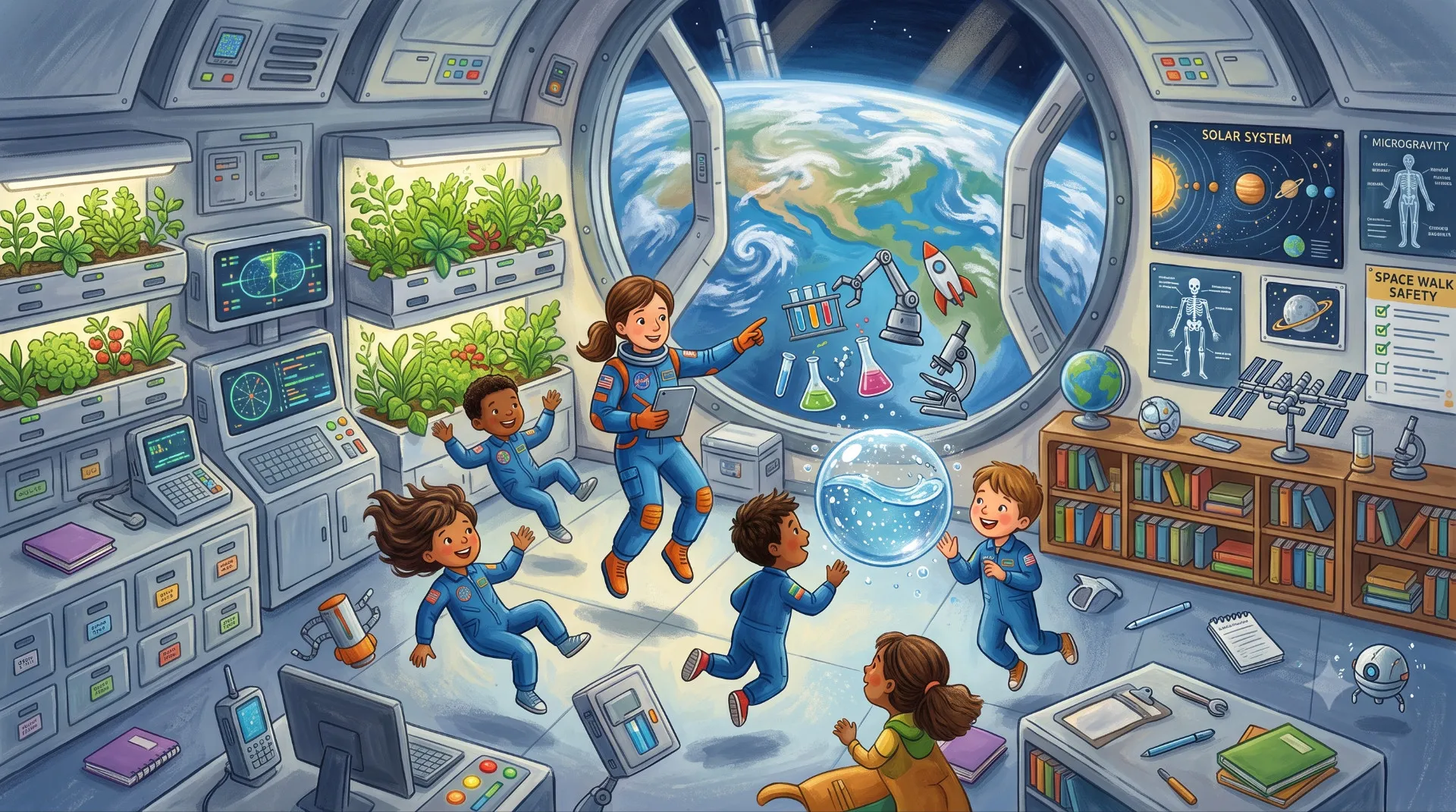
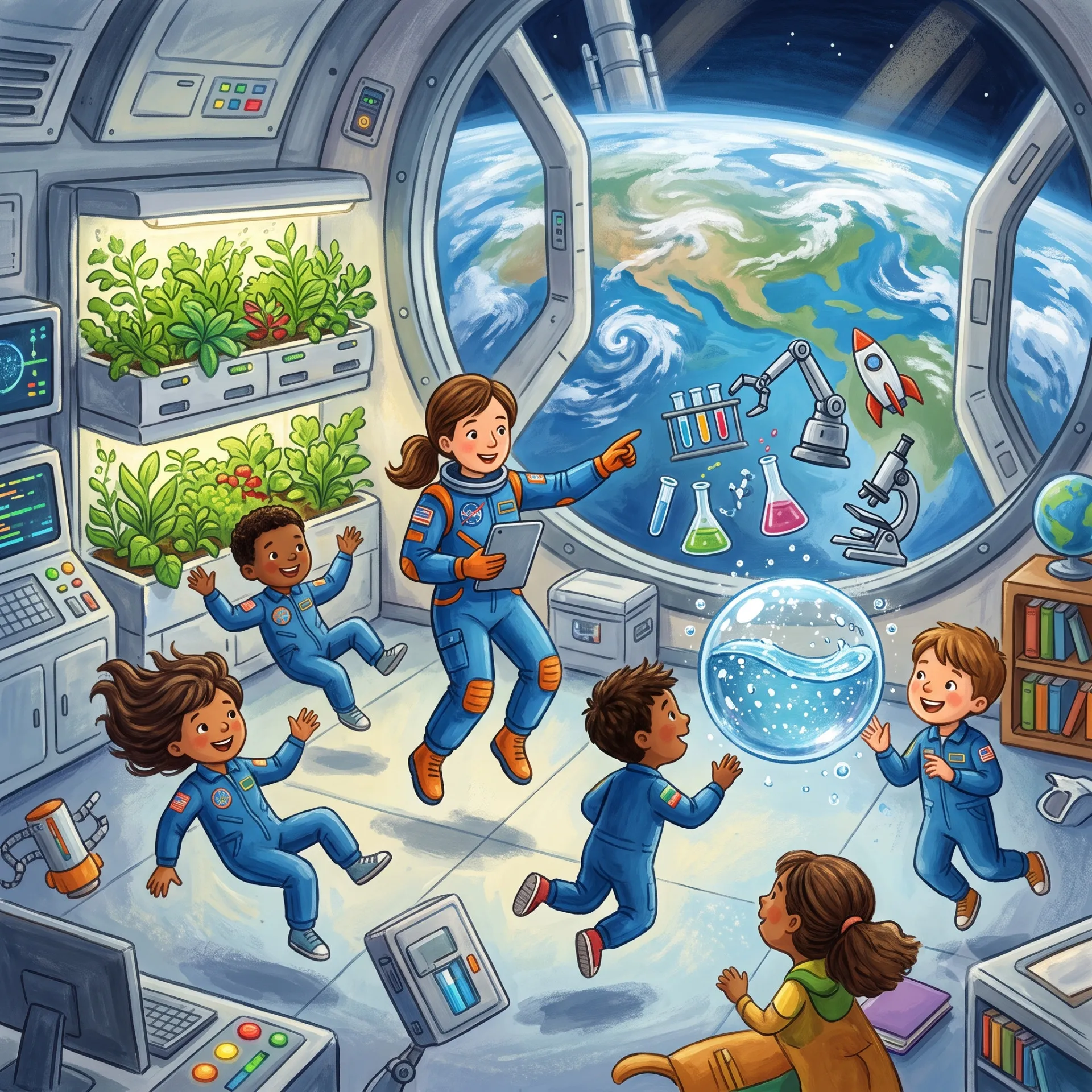
Instead of desks standing on the floor, small workstations were attached to the walls.
Students floated while holding onto handrails.
The classroom teacher greeted Noah warmly.
"Welcome to today's science lesson."
The first experiment involved two clear containers.
One contained water on Earth.
The other showed water inside the space station.
When the astronaut gently squeezed the water bottle, the water formed a floating ball instead of falling.
"It becomes a sphere because of surface tension," the teacher explained.
Noah carefully caught the floating water bubble.
It shimmered like a tiny crystal planet.
Next, the students planted seeds inside a special growing chamber.
"We study how plants grow in space," said the teacher.
"If astronauts travel to the Moon or Mars one day, they may need to grow fresh food."
Noah watched tiny green leaves reaching toward special lights instead of sunlight.
After class, Commander Elena showed Noah around the station.
The astronauts exercised every day using special machines.
"If we don't exercise," she explained, "our muscles and bones become weaker in microgravity."
Noah also visited the sleeping area.
Instead of beds, astronauts zipped themselves into sleeping bags attached to the walls.
"Do you ever fall out of bed?" Noah asked.
Everyone laughed.
"In space," one astronaut said, "there's no up or down."
Later, they entered the observation window.
The view took Noah's breath away.
Earth slowly turned beneath the station.
He could see snowy mountains, deserts, forests, oceans, and glowing city lights.
A bright sunrise appeared over the horizon.
Only forty-five minutes later, another sunset painted the sky with brilliant colors.
Commander Elena explained,
"The space station travels around Earth about once every ninety minutes."
"That means astronauts see many sunrises and sunsets every day."
Before it was time to leave, Noah received a small mission.
He had to carefully move a floating science notebook into a storage box without letting it drift away.
He worked slowly and stayed focused.
Mission complete!
Commander Elena smiled proudly.
"Being an astronaut isn't only about rockets."
"It's also about teamwork, patience, and careful thinking."
The shuttle gently returned Noah home before sunrise.
When he woke up, his science book was still open beside his bed.
He smiled.
Maybe it had only been a dream.
Or maybe...
...he had really visited the classroom above Earth.
Inspired by the adventure, Noah started a Space Science Club at school.
His classmates built simple models of satellites, learned about astronauts, and performed fun gravity experiments.
Years later, Noah became a space scientist, helping design equipment for future space stations and missions to the Moon.
Whenever children visited his laboratory, he pointed toward the sky and said,
"The greatest classroom doesn't always have four walls."
"Sometimes, it orbits our beautiful planet."
Vocabulary Words
The Moral
Space exploration helps scientists learn more about Earth, the universe, and the future of human discovery.
Life Lesson
Learning becomes exciting when we stay curious, work together, and are willing to explore new ideas.