The Little Letter of Encouragement
In a Nutshell
Emma nearly gave up on her invention after several failures, but mysterious notes of encouragement inspired her to keep trying. She completed her project successfully and later continued the tradition by encouraging others, proving that kind words can change lives.
Introduction
The Story
Oakwood Elementary School was famous for its annual Young Inventors Fair. Every student was encouraged to build something useful using simple materials such as cardboard, recycled bottles, wood, paper, or fabric.
Some children made bird feeders.
Others created toy bridges or miniature windmills.
The fair celebrated imagination rather than expensive projects.
Among the participants was eleven-year-old Emma.
Emma loved designing creative ideas in her notebook, but she rarely shared them with anyone.
She worried that people might laugh if her inventions didn't work perfectly.
This year, she decided to build a machine that collected rainwater for watering small gardens.
She carefully worked on it every afternoon for nearly three weeks.
But every time she tested it, something went wrong.
Sometimes the water leaked.
Sometimes the wheels jammed.
Sometimes the container tipped over.
By the final week before the fair, Emma felt discouraged.
"I don't think I'm good enough," she whispered while packing away her materials.
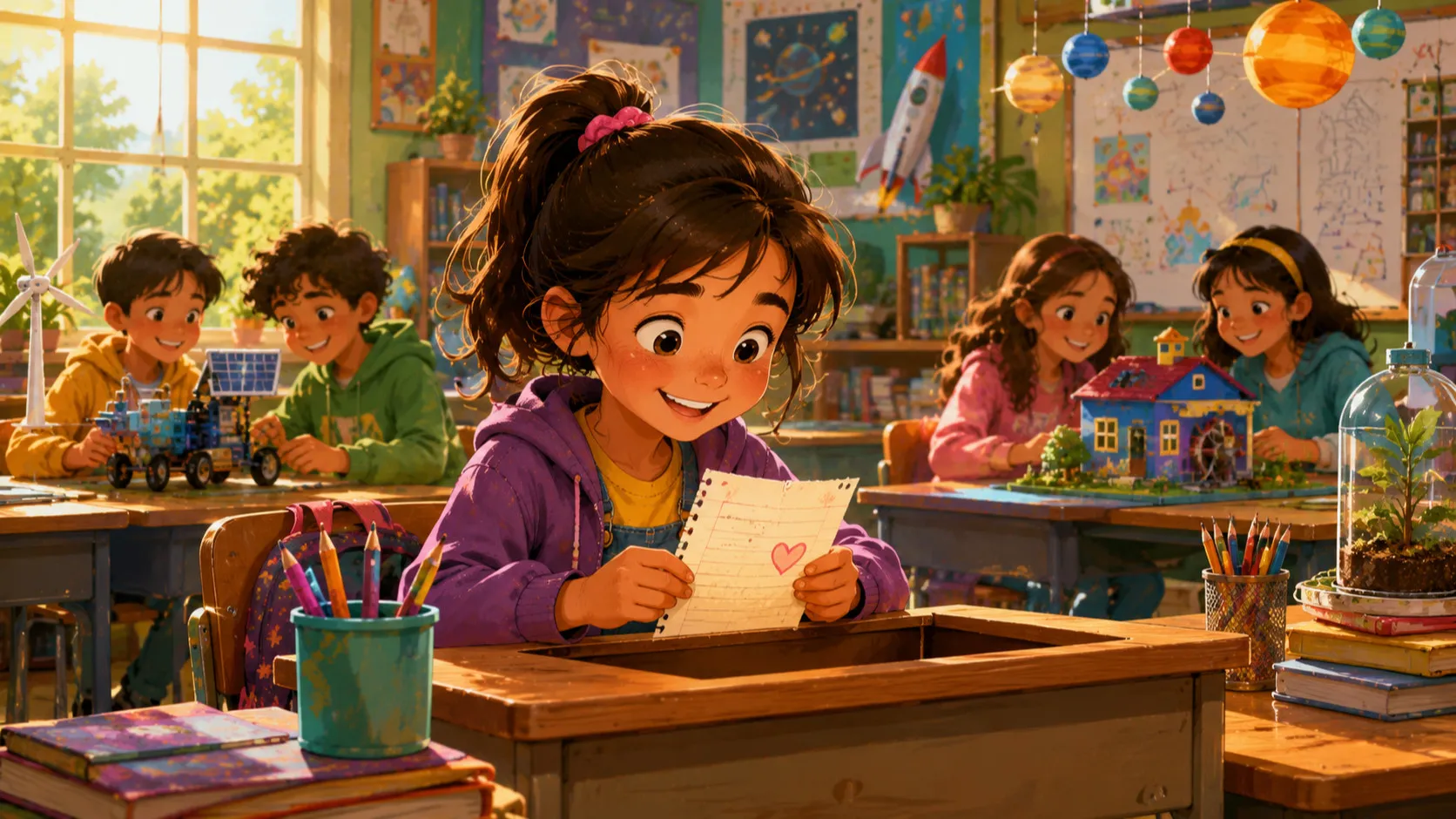
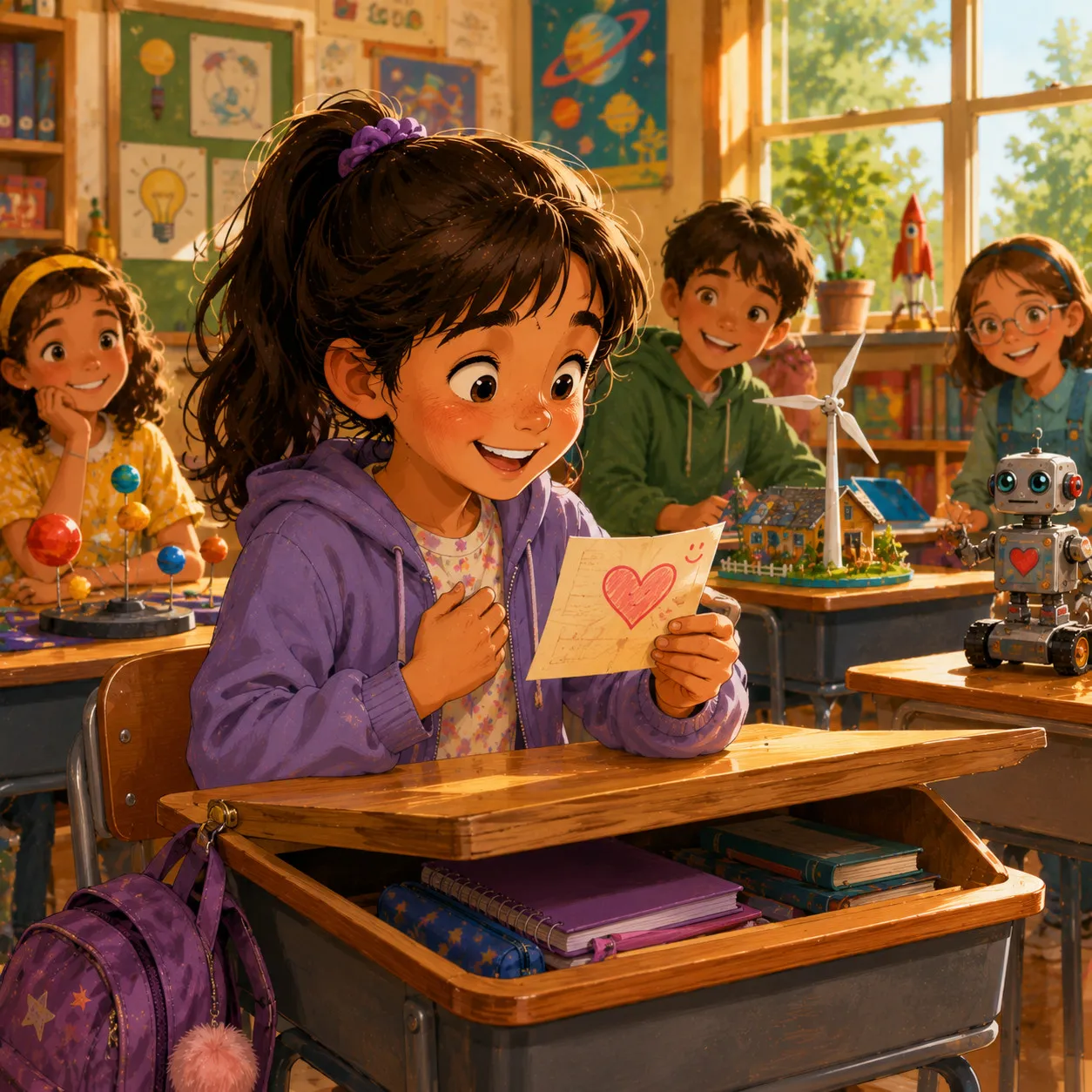
The next morning, when she opened her desk at school, she found a small folded note.
It simply read:
"Every inventor improves by trying one more time. I believe you can do it."
There was no signature.
Emma looked around the classroom.
No one seemed to know anything about the note.
She smiled and slipped it into her notebook.
That afternoon, instead of giving up, she tried again.
She strengthened the wooden frame.
She adjusted the water container.
She tested the wheels more carefully.
The machine worked better than before.
Not perfectly—but better.
The following morning, another note appeared.
"Mistakes are steps, not stop signs."
Again, there was no name.
Day after day, short messages appeared.
Each one encouraged Emma to keep improving instead of quitting.
She never discovered who wrote them.
By the day of the Young Inventors Fair, Emma's rainwater collector worked beautifully.
It gathered rainwater from a small rooftop model and directed it into a storage container that could water plants through a simple drip system.
Visitors admired how practical the invention was.
Although another student won the top innovation prize, Emma received the Creative Problem Solver Award.
She felt proud—not because of the certificate, but because she had refused to give up.
After the fair, Emma asked Mrs. Taylor, her science teacher, if she knew who had written the notes.
Mrs. Taylor smiled gently.
"I promised not to tell."
"But I can tell you one thing."
"The person believed your effort deserved encouragement."
Emma thought about those words for a long time.
Several weeks later, she noticed another student named Liam sitting quietly after art class.
His painting had accidentally been smudged, and he looked ready to throw it away.
Emma remembered the mysterious notes.
That evening, she wrote a small card.
"Every great artist begins with unfinished pictures. Keep creating."
The next morning, she quietly placed it inside Liam's art folder.
A few days later, Liam smiled more often.
He proudly displayed a beautiful new painting in the classroom.
Emma never told anyone about the note.
She simply enjoyed seeing someone regain confidence.
Soon, other students began leaving anonymous messages of encouragement for classmates preparing for spelling bees, music performances, sports competitions, and science projects.
The school created a special board called the Wall of Encouragement.
Students could pin kind messages, inspiring quotes, or thank-you notes for others to read.
The wall quickly filled with colorful cards.
Some messages were only a few words long.
"You've got this."
"Keep smiling."
"Your effort matters."
"I'm proud of you."
Teachers noticed a remarkable change.
Students became less afraid of making mistakes.
Instead of laughing when something went wrong, they encouraged one another to keep trying.
Years later, Emma became an engineer who designed water-saving systems for parks and schools.
On the first day of every internship program she supervised, each new student received a handwritten welcome card.
The message was always the same:
"Believe in your ideas. Every improvement begins with one brave attempt."
Many young engineers kept those cards for years.
Some even passed the tradition on to others.
Whenever Emma thought about the mysterious notes she had once received, she smiled.
She never learned who had written them.
But perhaps that didn't matter.
Because true kindness is not always remembered by the name of the person who gives it.
Sometimes it is remembered by the courage it awakens in another heart.
Vocabulary Words
The Moral
Kind words can give someone the courage to achieve great things.
Life Lesson
Encouraging others costs nothing, but it can inspire confidence, hope, and determination that lasts for years.